
NEW ITEMS


A0426 17TH OR 18TH CENTURY TURNED IVORY BOWL COMPASS
This fabulous early compass is the first we have ever seen. Composed of a papers compass rose on which a steel needle pivots. The cardinal points are marked in English with the north point with typical fleur-de-lis with possible initials within the point. Housed in a fine turned ivory bowl, with four sides carved with lion faces and carved floral designs in between. There is a silver point mounted on the edge of the bowl. There is a turned wood base at the bottom on which the paper card is attached. 3 ¼ inches diameter by 1 3/8 high.
$3500


A0427 RARE LEATHER NAVAL CARTRIDGE PASSBOX FOR 24 PDR. CANNON
The passbox was used to carry gun powder cartridges up to the gundeck by young boys called powder monkeys. This is a rare survivor made at the Boston Navy Yard and so stamped on the bottom, USNY BOSTON with painted designation: 24 PDR. Sewn heavy leather with attached lid and sling which is broken. 14 inches by 8 ½
$1650


A0431 19TH CENTURY SCRIMSHAW WHALE IVORY AND WHALEBONE CANE WITH TURKS HEAD KNOB
Finely crafted from a whalebone twist shaft with a whale ivory turks head knob with metal double separator. Very fine condition. 36 ¼ inches long.
$1850
A0432 19TH CENTURY SCRIMSHAW WHALE IVORY AND WHALEBONE LADY’S CANE.
The whalebone shaft topped with a faceted marbled whale ivory head. The shaft carved with cross-hatch decoration, followed by exceptional spiral twist with thin beading between. Very fine condition.36 ½ inches.
$1500
A0433 19TH CENTURY SCRIMSHAW WHALE IVORY AND WHALE IVORY CANE.
Uncommon cane constructed with a four‑column split whalebone shaft, each column cleanly carved and arranged to create a sculptural, architectural profile. The shaft is further embellished with carved decorative diamond motifs that bracket the shaft. Shaft is topped with faceted whale ivory knob with thin baleen spacer. 36 ¼ inches.
$2600


A0429 LARGE SHARK VERTEBRAE WALRUS IVORY CANE
19th century sailor made heavy scrimshaw cane made from thick shark vertebrae with angled walrus ivory handle, complete with metal tip. Wood spacer between handle and shaft,. Fine condition. 34 inches.
$600
A0430 19TH CENTURY SCRIMSHAW WHALE IVORY AND WHALEBONE CANE
Made with an angled handle of whale ivory and bands with baleen separators, leading down to a spiral twisted shaft. Fine condition overall. 35 1/5 inches long.
$1200


A0428 SHIP’S CARPENTER’S PLANE MARKED SHIP DELAWARE
We’ve never seen a carpenter’s plane marked with a ship’s name before making this example possibly unique. It dates early to mid 19th century and show evidence of extensive use. There is no other marking. The wedge finial was broken off at some point. If only it could talk. There were many vessels named Delaware so it’s impossible to identify a specific vessel by that name. 9 inches long.
$325
SOLD


A0434 SET OF FAROE ISLANDS WHALING KNIVES
A fine set of handmade whaling knives, purchased in the Faroe Islands during the early 1970s. These traditional whaling knives reflect both the functionality and cultural heritage of the unique whaling practices in the region. All three knives were crafted by P.Z. Hansen, a renowned bladesmith who held appointments to the Royal Danish Court, the Royal Swedish Court, and the Royal Norwegian Court. His workmanship is masterful—while these knives could certainly serve as tools, they were more likely intended as prestigious gifts, much like the enduring tradition of the Nantucket Basket, which continues to be handcrafted today in the same way it was a century ago.
The largest knife features a 7 ½-inch steel blade with a subtle clip point, a cross guard with ball finials, and an ebony handle inlaid on both sides with pilot whales, hearts, and intricate silver wire in a serrated pattern. Measuring 13 ¼ inches overall, the knife rests in a beautifully decorated ebony sheath, divided into four panels adorned with silver whaling implements, a pilot whale, and a large hook. Three inset silver bands strengthen the length, while each silver end cap of both the sheath and handle is stamped ZH/925s. In pristine, unused condition.
$1500


A0435 SHIP CHANDLER ROPE MEASURING GUAGE.
Wood and brass rope measuring gauge made by WHITLOCK CORDAGE CO. Jersey City. NJ, opened in 1815 and moved to NJ 1905
$195
A0436 NEW BEDFORD SHIP CHANDLER ROPE MEASURING GUAGE.
Wood and brass rope measuring gauge made by NEW BEDFORD CORDAGE CO. Broadway, NY and New Bedford. Operating from 1842-1961.
$250


A0416 CARVED 19TH CENTURY FIGUREHEAD OF A STATESMAN.
A finely carved three‑quarters figurehead depicting a well‑dressed, bearded gentleman holding a scroll in his left hand, likely intended to represent a statesman or civic figure. He wears a painted blue coat over a brown waistcoat and white shirt, finished with a painted bow tie. The lower section terminates in boldly carved folded drapery that wraps toward the back.
The reverse is flat, with the original lacing piece intact. A drift‑pin hole is cut through the back, accompanied by a narrow vertical mortise extending downward and continuing across the base—features consistent with traditional mounting practices. The figurehead is carved from a single block of pine, with separately applied elements forming the outer portions of the arms.
Condition: The carving exhibits two older repaired cracks running vertically along the right side. These repairs remain stable, and the figurehead overall is structurally sound. Height 43 inches.
$10250


A0396 PEACE PIPE BELONGING TO CHIEF RED SHIRT
This important Native American artifact was given to Frederick C. Monier by Chief Red Shirt in 1902, according to Monier’s handwritten list of relics he received from performers associated with Buffalo Bill Cody’s Wild West Show. Monier recorded that he had first known Red Shirt as early as 1885, and the two met again at the Monier's home in 1902, where this pipe was presented.
The artifact itself is a classic Sioux ceremonial pipe, featuring a catlinite (pipestone) T‑form bowl finely incised with crossed geometric lines. The bowl, once cracked, has been professionally repaired, preserving both its structural integrity and its visual harmony. The swirl‑twisted wooden stem is superbly crafted, displaying a deep, dark patina developed through age and handling. The pipe measures 25 ¾ inches in overall length, its proportions and workmanship reflecting the ceremonial importance such objects held within Lakota culture.
In his notes, Monier described Red Shirt as a friend of President Ulysses S. Grant, who had presented him with a peace medal—an indication of the chief’s stature and diplomatic presence during the late 19th century. Monier observed that Red Shirt could speak English but preferred to use an interpreter, a detail that underscores both his multilingual ability and his preference for formal communication. In a striking anecdote, Monier wrote that Red Shirt “would not speak to Queen Victoria,” a remark that hints at the chief’s strong sense of autonomy and personal dignity during his time associated with the Wild West Show.
$7500
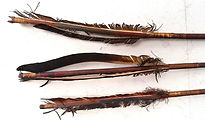


A0395 NORTHERN PLAINS (SIOUX) INDIAN BOW AND ARROWS ca. 1885
This hardwood Sioux bow and three arrows were given to Frederick C. Monier Sr. (1845-1927) by Texas vaquero and Wild West Show performer Joe Esquivel around 1885, recorded as item 21 in Monier’s catalog of gifts from Buffalo Bill Cody’s troupe. The 42.5‑inch bow retains its original sinew string and Monier’s brass inventory tag. The accompanying arrows preserve their original fletching, painted blue and red bands, grooved blood lines, and metal trade points, reflecting late‑19th‑century Northern Plains craftsmanship and the personal exchanges behind Cody’s early Wild West Show.
Frederick Charles Monier (1845–1927) was an enthusiastic admirer of Buffalo Bill Cody and developed close friendships with Cody and many of the performers in the Wild West Show, including numerous Native participants.
The Esquivel brothers Joe and Antonio, were seasoned Texas vaqueros who had worked on cattle drives across the Southwest. Their exceptional horsemanship and trick‑riding abilities caught the attention of Buffalo Bill, who recruited them as lead cowboys for his newly established Wild West Show.
$3500


A0414 LARGE PERIOD HALF HULL MODEL OF AN ARMORED CRUISER EARLY 20TH CENTURY.
A substantial and finely made half‑hull model, likely representing a vessel of the Pennsylvania‑class armored cruisers—six ships constructed during the first decade of the 20th century. The model features a solid painted hull with integral deck fittings and structural indications consistent with early steel‑navy cruiser design.
It is mounted on its original backboard, which retains a well‑molded border and its original painted surface. The reverse bears an indistinct cursive inscription, suggesting early ownership or shipyard association.
Overall dimensions: 59 x 18 ¼ inches.
$1500
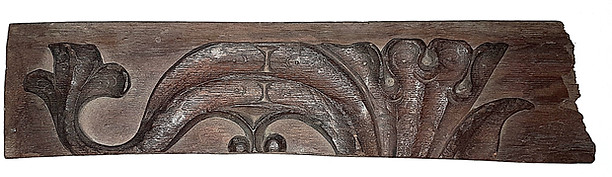
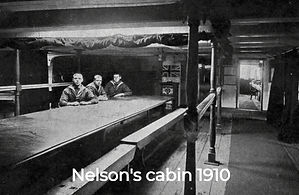
A0420 CARVED FRAGMENT FROM NELSON’S CABIN ABOARD HMS VICTORY, 18TH CENTURY
This carved wooden fragment was removed during the restoration of Admiral Lord Nelson’s flagship, HMS Victory, in the 1920s. A contemporary typed label—stamped SOCIETY FOR NAUTICAL RESEARCH and numbered 27—states that the piece came from Nelson’s cabin and was sold to raise funds for the ship’s preservation.
The carving exhibits characteristics of late‑18th‑century decorative work and may represent a surviving element of Victory’s original cabin fittings. Such fragments were occasionally retained when deteriorated or altered sections of the ship were replaced during early conservation efforts.
The piece measures 11 1/2 × 2 3/4 inches.

$425
SOLD


A0421 PRESENTATION ROCKER INK BLOTTER FROM HMS VICTORY, EARLY 20TH CENTURY
A finely made early‑20th‑century presentation ink blotter constructed from three pieces of oak timber and copper sheathing salvaged from HMS Victory, Lord Nelson’s flagship at Trafalgar.
The handle is carved in the form of a ship’s capstan, neatly mounted into a thin oak plate incised to resemble deck planking, an intentional nod to the vessel’s original fabric. Affixed to the front is a copper sheathing plaque reading:
“Presented to Mr. G. Cole by the Senior Rates Mess H.M.S. Victory Oak and sheathing from H.M.S. Victory.”
Dimensions: 6 ¾ × 3 3/8 inches.
$225
SOLD


A0413 LARGE STERLING SILVER FOOTED SALVER PRESENTED TO CAPTAIN WILLIAM SCORESBY JR., 1817
Handsome and historically important sterling silver footed salver presented to Captain William Scoresby Jr. of the whaling ship ESK. Struck with London hallmarks for 1816/17, maker Walter Brind. Diameter 12 in., height 1.5 in., weight 36 oz.
The finely engraved presentation reads: “Jan. 1st 1817. The Whitby Underwriters to Capt. Wm. Scoresby Jr. of the ship ESK as a remembrance of his meritorious exertions sustained in the Greenland seas last season, and bringing the ship into Whitby harbour, 27 July 1816.”
William Scoresby Jr. (1789–1857)—master mariner, scientist, and author—was born near Whitby and entered the Greenland whale fishery under his father aboard the Resolution. In 1806 he served in the Royal Navy aboard HMS Alfred during the Copenhagen operations. Through his acquaintance with Sir Joseph Banks, Scoresby was encouraged to pursue systematic scientific study of the polar regions, work that would later define his reputation.
In 1813 he took command of the newly built ESK, continuing his program of scientific observation and inventing an apparatus for measuring deep‑sea temperatures. During the 1816 voyage, the ESK was caught between two ice floes and, upon breaking free, struck a projecting tongue of ice that tore a large hole in her bottom. Facing imminent loss of the vessel, Scoresby and his brother succeeded in stemming the leak and navigating the damaged ship safely back to Whitby on 27 July 1816. In recognition of this feat, the Whitby underwriters presented him with the silver salver offered here.
Scoresby later recounted the dramatic incident in his 1820 work The Northern Whale Fishery.
$5500


A0425 EXCEPTIONAL WHALING MINCING KNIFE WITH SHEATH.
A blubber mincing knife used in the American whale fishery, complete with its original wooden sheath. A double‑handled example retaining its original wooden grips, with ferrules reinforcing the forward end of the handles. The blade measures 24 inches in length and shows clear evidence of heavy service, including losses at both ends from repeated sharpening.
A convex iron stiffening rib, approximately 1 inch wide, runs along the spine of the blade and is riveted in place. The surface retains traces of its rust‑preventative orange paint. Overall length, including the handles, is approximately 35½ inches.
The knife is accompanied by its original wooden sheath, constructed from two pieces of pine fitted to the blade.
$1800


A0410 IMPORTANT 18TH CENTURY CARVED BUSK DEPICTING ACTIVE SPERM WHALING SCENE.
An exceptionally important—and quite possibly the earliest known—18th‑century corset busk carved in relief with a vivid representation of sperm whaling. Fashioned from maple and dated 1761, the busk features a finely executed scene that is remarkable both for its subject matter and its early date.
On the left, an 18th‑century sloop is shown under sail, flying a pennant bearing the cross of St. Andrew or St. Patrick. To the right, a whaleboat is depicted in active pursuit, with the harpooner already fast to a sperm whale—an unusually dynamic and detailed portrayal for a busk of this period. Above the scene appears the inscription “AD 1761”, and centered near the top is a decorative chip‑carved fan motif.
The reverse bears a lightly penned ink inscription reading: “Property of Stephen B. Dean.”
Stuart M. Frank, PhD, Senior Curator Emeritus of the New Bedford Whaling Museum, has recorded that he is reasonably certain the piece was crafted by Stephan Dean (1724–1797) of New York, who was employed as a sailor.
Dimensions: 11 ½ inches.
$8250


A0415 FINELY ENGRAVED SCRIMSHAW CORSET BUSK WITH ALLEGORICAL VIGNETTES
The unknown scrimshander who created this corset busk was a true artist, working with a precision and delicacy that elevate the piece far beyond simple ornament. The surface is engraved with a sequence of finely rendered vignettes, each carefully transferred from contemporary printed sources and arranged in a graceful vertical progression.
At the top, twin fountains spill from a large classical urn, flanked by birds perched lightly on its handles. Below this, the figure of Minerva, goddess of war and wisdom, stands before an American flag—an early patriotic motif that continues in the next panel, where Liberty appears draped in classical robes, leaning upon an American shield with supporting eagle and globe. The final vignette depicts Cupid, bow drawn, poised to release an arrow of love.
The imagery is crisp, balanced, and unusually sophisticated for a busk, suggesting a maker with both artistic training.
Excellent condition.
Length: 13 inches.
$2500


A0379. SHIPBOARD‑MADE SCRIMSHAW CARPENTERS SQUARE
A finely crafted sailor‑made carpenter’s square fashioned from a thick section of sperm whale panbone, its outer end shaped with a subtle decorative flourish. The bone blade is fitted to a wooden handle, forming a sturdy and functional right angle.
Dimensions: 9 7/8 × 8 5/8 inches.
$275
ADMIRAL JAMES BURNEY'S POCKET COMPASS ON CAPTAIN COOK'S VOYAGE


A0392 IMPORTANT POCKET COMPASS BELONGING TO ADMIRAL JAMES BURNEY CAPTAIN COOK
This 18th century pocket compass is probably the most historical item we have every had. It belonged to Admiral James Burney who accompanied Captain James Cook on Cook’s last two voyages to the Pacific and was witness to the killing of Cook at the hands of the Hawaiians.
This is a typical 18th century portable pocket compass that was commonly carried by naval officers. It houses an unsigned engraved paper compass rose, a magnetized steel needle pivoting on a central pin. Mounted under glass in a mahogany case with hinged lid and brass catch. An early manuscript label attached to the underside of the lid reading “Belonged to Admiral James Burney who went round the world with Capt. Cook”. An ornate silver initial “B” was attached to the outside lid at some point in the 19th century.
Provenance
This compass descended through the Burney family: James Burney (1750-1821) was the son of Dr. Charles Burney (1726-1814) and brother of novelist Fanny Burney. His elder sister, Esther, married her cousin Charles Rousseau Burney (1747-1819) whose family the compass was passed down to James Henry Guy Burney (1914-1982), three-times great-grandson of Charles Rousseau Burney, which was then passed on to Simon Fraser, RN. four-times great-grandson of Charles Rousseau Burney.
Biography
James Burney was an English explorer and writer born 1750. He began his service in the Royal Navy at the age of ten as a “Captain’s Servant” on board HMS Princess Amelia. After serving in several ships and promoted to midshipman, he began the great adventure with Captain James Cook on his last two voyages to the Pacific. Afterwards Burney served aboard HMS Cerberus blockading Boston during the American Revolution. After his retirement from the Royal Navy he wrote several books including the 5 volume set, Chronological History of the Voyages and Discoveries in the South Sea or Pacific Ocean (London, 1803–1817). Note that the compass comes with Volume II which covers the early expeditions in the 16th and early 17th centuries. This includes the exploration by Sebastián Vizcaíno of California.
Cook’s Voyages
On the second of Cook’s voyages, Burney was promoted to lieutenant aboard the Adventure, the consort ship of the Resolution. He served as interpreter and friend of Omai after returning to England. On Cook’s third voyage to discover the fabled Northwest Passage, Burney served aboard the Discovery. He was witness to the death of Captain Cook at the hands of the Hawaiians. He took command of the Discovery upon the death of Captain Clerke and returned to England. His personal journal records in detail the third voyages with Captain Cook and his death.
James Burney certainly carried this compass with him while he was on the voyages of discovery with Cook. He surveyed and made charts while serving aboard the Adventure and Discovery.
$14750


A0412 RARE PAIR OF WHALEBOAT PADDLES
A rare pair of wooden whaleboat paddles, each hand-lettered L Boat on the blades. The blades are fashioned from single pieces of pine, reinforced with a horizontal strip of wood, and riveted securely to their handles. Although clearly made by the same hand for the same vessel, the two paddles did not remain together.
The longer example, measuring 78.5 inches, was deaccessioned from the Independence Seaport Museum in Philadelphia, having originally entered that institution from the Valley Forge Historical Society in the 1960s. The shorter paddle, 55.25 inches, came from the collection of Robert Hellman, who acquired it from the Clifford Ashley collection. It was attributed to the whaling bark Sunbeam, on which which Ashley sailed in 1904 and documented with a series of photographs.
At some point, the shorter paddle was cut down; its blade now sits slightly loose and shows greater wear than its companion.
$1400
SOLD


A0400 WHALECRAFT DOCUMENT: PELEG BUTTS OUTFITS FOR BARK MASSACHUSETTS
Rare signed receipt from Peleg Butts & Son, noted whalecraft makers, detailing the outfitting of the bark Massachusetts.
Dated 1856, the document itemizes an extensive list of whalecraft supplied, including:
Three types of harpoons: double‑flu, single‑flu, and toggle irons, Cutting spades, Blubber hooks, Blubber forks, Along with numerous other essential implements for the whaling voyage
This receipt represents a rare surviving record of mid‑19th century whalecraft provisioning, signed by one of New Bedford’s prominent makers.
$150 SOLD


A0409 EARLY DOUBLE FLU MOUNTED HARPOON
An early, unmarked double‑flue harpoon, possibly 18th century.
This rare example features unusually narrow barbs tapering to a fine shank with split‑seam socket. The iron remains authentically mounted on its pole, bound with hemp serving and rigged with rope of the period. Measuring an impressive 100 inches overall (38 inches for the iron alone), this harpoon represents a scarce survival from the age of sail and whaling.
$1750
SOLD


A0408 RARE WHALING BLUBBER SKIMMER
A fine and rare blubber skimmer, preserved on its original sapling pole.
The basket is fashioned from two pieces of sheet iron, riveted to an iron support at the base, with a long shank terminating in a socket. It is secured by a bolt to the pole. Overall length measures 103 inches, with the iron portion extending 39 inches.
This specialized tool was employed aboard whaling ships to skim scraps of blubber from the oil boiling in the try-pots.
$1850
SOLD


A0391 CLIPPERSHIP SAILING CARD FOR THE SHIP “TWILIGHT”
Advertising for the California Line For San Francisco. The TWILIGHT sailing card is quite scarce. She was built in 1857 at Mystic Connecticut by Charles Mallory for the California trade. The card dates late 1860s. Condition good with edge spotting. 10.3 x 16.5 cm.
$550


A0389 CLIPPERSHIP SAILING CARD FOR THE SHIP “ASA ELDRIDGE”
Advertising George D. Sutton’s Clipper Line for San Francisco, The A1 Popular Clipper ASA ELDRIDGE, under Captain Kelly. The date of this card is 1869 when Kelly took command.The ASA ELDRIDGE was named for Captain Asa Eldridge of Yarmouth Port who had died in 1856. 10.3 x 16.5 cm.
$425


A0397 RARE LITHOGRAPH OF UNITED STATES FRIGATE ST LAWRENCE 50 GUNS SALUTING OFF OSBORNE, ISLE OF WIGHT.
This rare lithograph by Dutton and printed by Day & Sons Lith. To the Queen, Depicts the American frigate saluting Queen Victoria off her residence on the Isle of Wight. May 5th 1851. Under commend of Joshua Sands to who the print is dedicated, the St Lawrence arrived in England carrying exhibits from the United States for the Great Exhibition in London. 21 1/8 x 27 1/8.Print has full margins, some areas of discoloration and repaired margin flaws.
$395


A0373 SCRIMSHAW TOOTH BY MOSES DENNING DATED 1837

Obverse depicts a naval ship set with full sails flying a huge American flag and a long pennant from the main mast. Four birds, soar in the sky above the ship. The ship is rides upon the water in the form of a fanciful sea serpent. Reverse with a full-length portrait of a young woman wearing an elaborate comb in her hair, a blouse with puffy green sleeves, a long skirt with red cross-hatch design with black and red hem with her tiny feet protruding. In her hands she is holding a purse. Condition as seen with chipping at base and tip. Length 6 5/8.
Moses R. Denning (1806-1884) Was from Poland Maine and is recorded as a crew member aboard the whaleship Nassau on a voyage of 1833-1837. He subsequently became a farmer in Auburn Maine. A signed example is in the collection of the New Bedford Whaling Museum.
$7500


.jpeg)

A0384 WHALING COMMON LANCE MOUNTED ON ORIGINAL POLE.
This lance was formerly in the collection of Valley Forge Historical Society and later in the Independence Seaport Museum. It was part of a whalecraft collection believed to have come from the whaling bark WANDERER. The lance appears to have never been used which makes sense if it was retrieved from the wreck. Its in fine condition with just light surface rust and retains most of the socket serving. The pole’s original warp line rigging was missing, replaced by a modified system in which grooves were carved in the pole where the warp line was seized. Because this was not the correct way lances were rigged, we re-rigged it correctly running the warp line through the original hole at the end of the pole and splicing a loop at the end. We used authentic old warp line to rig it. Overall length: 134.25 inches, the iron 65 inches. NOTE: The iron can be detached from the pole to allow shipping.
$1250
SOLD


A0356 RARE EARLY 18TH CENTURY REVERSE TAPERED TELESCOPE C. 1740
This is the earliest telescope we have ever had. Wood tube marble-grained in red and black paint. No draw, focus made by screw thread on the brass ocular lens assembly with sliding cover. Optics okay but not very sharp. Brass Objective lens lacking sliding protective cover, length 38.5 inches.
An almost identical spyglass is in the collection of the Peabody Essex Museum which belonged to Massachusetts military officer Thomas Nixon during the French & Indian Wars.
$1750


A0364 19TH CENTURY WHALE IVORY SCRIMSHAW PIE CRIMPER
Made from a single large Sperm whale tooth with delicate open work in the handle and pierced hearts star and crosses in the fan tail. Large solid fluted whale ivory wheel. 7 .75 inches overall. Wheel has slight warping, otherwise fine condition. 1100
$1100


A0343 GOLD RUSH PERIOD LETTER WITH VIVID ACCOUNT OF THE KILLING OF JOAQUIN MURRIETA.


“The story runs that the company raised for the purpose of ferreting out these desperadoes encountered them near the Mariposa, and after a running fight at the length took several prisoners, and killed both Joaquin and another deep-eyed villain called three fingered Jack.”
This rare first hand account of Murrieta is part of a letter written by Joseph G. Eastland to Edward D. Hicks on Donahue's Union Iron and Brass Foundry letter sheet. Eastland came to California with his father in 1849 and founded the town of Oro. In 1851 he entered the Union Foundry under Donahue.
Eastland records that Murrieta's head was cut off and preserved in spirits to obtain the reward.
$3500


A0330 PAIR OF SCRIMSHAW POLYCHROME TEETH BY THE THISTLE ENGRAVER C. 1840
The Thistle Engraver, so called, is known for his garlands of thistles surrounding ships and figures. His work is beautifully executed with color. This pair depicts on the obverse, ships titled "Outward Bound" and "Home Bound". The reverse male and female figures in Scottish dress depicted with the national flag of Scotland. The figures may represent Rob Roy MacGregor and his wife Mary.
The teeth measure 5.5 inches. The teeth have old chips on the tip and base.
$4500
SOLD


A0322 18TH CENTURY SAILOR MADE WOOD BUSK
This 18th century busk is finely engraved with pinwheel, floral design, intertwined hearts with chip carved decorations. But significantly is engraved a portrait of a topsail schooner and identified "THE SCHOONER RAINE"
It was probably made by a sailor or master of the vessel as a memento to his wife or sweetheart.
Provenance: The William Guthman Collection
$1500


A0301 THE ANDREW INDERWICK NAVAL ARCHIVE 1807 - 1820
This archive consists of 13 letters written by Andrew Inderwick, Royal Navy officer who served aboard several warships during the Napoleonic and War of 1812. He details accounts of the growing conflict between Britain and the Americans. Includes details of clashes with the America.
One fascinating account describes a strange creature found dead on a beach 35 feet in length and having hoofs like a horse. Inderwick records the account from the captain of the brig Slade that was under convoy of HMS Crocodile. A complete summery of each letter is available upon request.
$2750


A0335: FINE CLIPPERSHIP CARD FOR SHIP PURITAN
A very fine large sailing card for the Boston ship PURITAN, captain Allen Knowles for the Glidden & Williams Line.
Probably dates 1866 for her maiden voyage to San Francisco.
Watson & Clark Printers.
This card is in extremely fine condition and measures 17 x 10.7 cm.
$1250


A0323 EARLY CLIPPERSHIP CARD FOR SILVER STAR 1856
A fine early sailing card for the short lived ship SILVER STAR, Captain Wade for the Sutton & Co's Dispatch Line. This advertisement was for her maiden voyage in 1856. She was built at Medford MA that year for the San Francisco route. She was wrecked 1860 on Jarvis Island in the Pacific.
These early sailing cards were smaller than the later cards from the 1860s and 70s. This one measures 5 1/4 x 3 inches and is in fine condition.


